
Hormuz oil is moving again, so why are fuel and food still so expensive?
Tankers are carrying crude through the Strait of Hormuz at close to pre-war levels. But diesel, petrol and food prices are still high, because the Gulf's refined fuel has not come back. Here is what that means for your bills.


Tankers are moving through the Strait of Hormuz again. Crude oil shipments through the waterway have climbed back close to where they were before the war, according to tanker-tracking firm Kpler, as IBTimes and National Security Journal reported this week.
So why does filling a tank, running a truck or buying bread still cost so much more than it did in February?
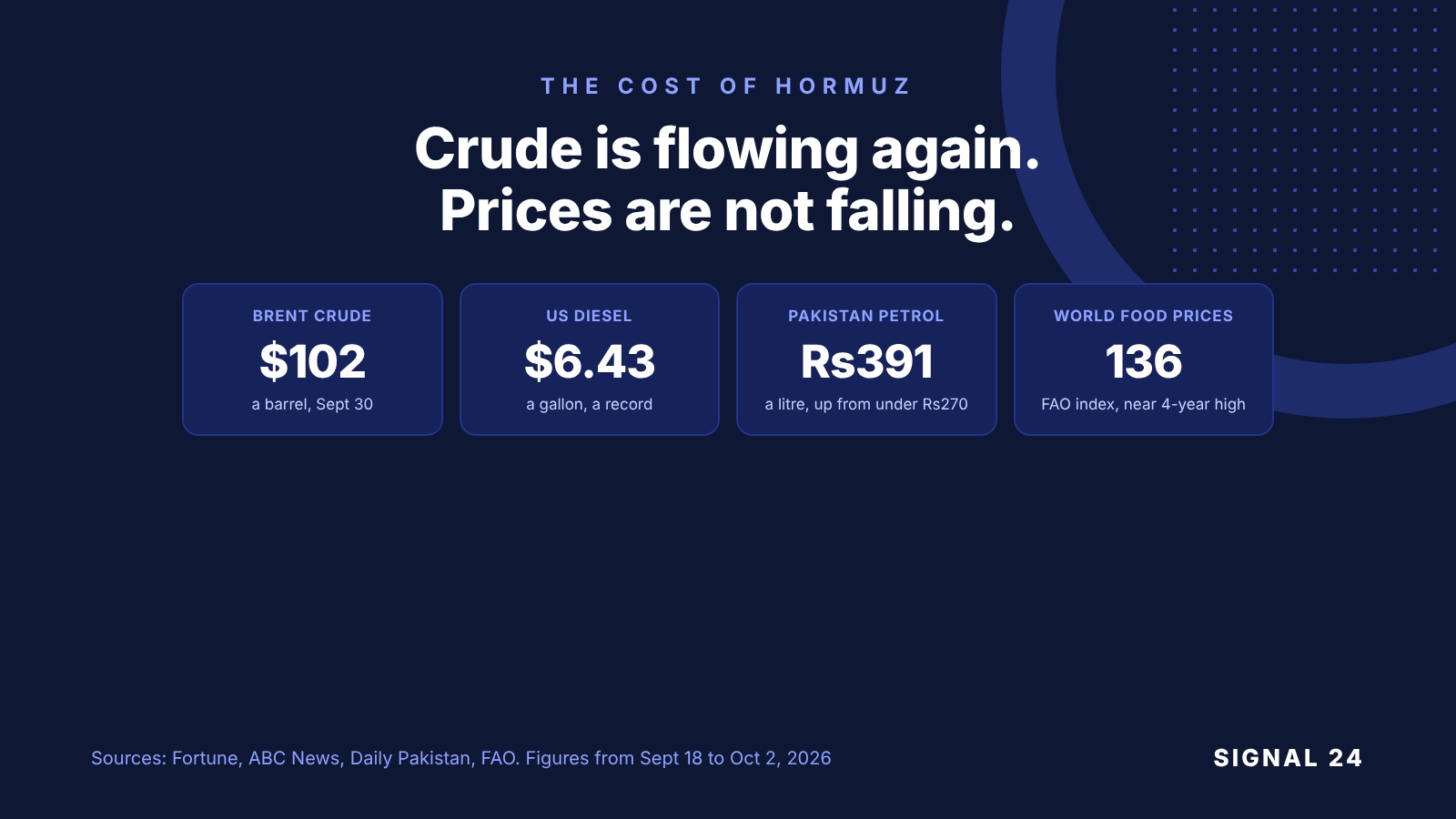
Graphic: Signal 24. Sources: Fortune, ABC News, Daily Pakistan, FAO.
The short answer is that the world is not short of crude right now. It is short of the fuel made from it.
Crude is back, fuel is not
The Gulf does not only export crude. Before the war, its refineries also shipped huge amounts of diesel, jet fuel and other finished products through Hormuz.
That part of the trade has not recovered. Kpler data cited by IBTimes puts refined product shipments through the strait at about 677,000 barrels a day, against 3.6 million before the war. National Security Journal describes those shipments as "a tiny fraction" of pre-war levels, with refining capacity in the region "severely damaged".
Diesel is the clearest example. Gulf diesel and gasoil exports averaged only about 390,000 barrels a day in August, roughly a quarter of pre-conflict levels, according to IEA and Platts figures reported by People's Daily.
Not everyone agrees on how much crude is getting through. Kpler counts nearly 12.5 million barrels a day in the week to September 27, while maritime analysts at Windward put it closer to 10 million, National Security Journal reported. Either way, prices have not come down. Brent crude traded at $102.56 a barrel on September 30, up from $91.94 a month earlier, according to Fortune. Daily Pakistan put it at $103.86 a day later.
Diesel at record highs
Diesel is the fuel of trucks, tractors, ships and generators. When it gets expensive, the cost spreads into almost everything.
In the United States, diesel has gone past its previous record of $5.81 a gallon, set in June 2022. The US government's on-highway average reached $6.29 on September 14, the road transport body IRU said, and ABC News reported an average of $6.43 a few days later.
In the European Union, diesel averaged around €2.25 a litre in mid-September, according to both IRU and People's Daily. IRU says that is 38 percent more than on February 27, the day before the war began.
At the pump
Petrol is also high. The US national average for a gallon of regular was $4.48 on September 24, the highest ever for that time of year, motoring group AAA said. ABC News had it at $4.47 a week earlier.
Countries that import almost all their fuel feel it harder. In Pakistan, petrol cost under Rs270 a litre before the war. From October 2 it costs Rs390.66, according to Daily Pakistan and Bloom Pakistan. Arab News calculated last week that petrol and diesel there were still about 46 percent more expensive than before the conflict.
From the fuel tank to the dinner table
Food is where the pressure lands next. The UN Food and Agriculture Organization's food price index rose to 136.0 points in September from 134.0 in August, its highest in nearly four years, according to World Grain and Xinhua.
Hormuz is part of the reason. FAO said uncertainty over shipping through the strait kept concerns about fuel, fertiliser and freight costs high. Up to 30 percent of the world's traded fertilisers normally pass through Hormuz, the FAO warned back in March, along with a fifth of the world's liquefied natural gas, which is used to make nitrogen fertiliser.
FAO chief economist Maximo Torero warned that these costs "could eventually be passed on to consumer food prices, particularly in countries dependent on food and energy imports", Xinhua reported.
Higher prices, higher interest rates
Expensive energy is also keeping borrowing costs up. The US Federal Reserve raised interest rates by a quarter point to a range of 3.75 to 4 percent on September 16, according to Charles Schwab and Chase. Fed Chair Kevin Warsh said inflation "is too high, and has been for too long."
The effect does not stay in America. Higher US rates tend to push the dollar up, and because oil is priced in dollars, that makes every barrel cost more for importers such as Pakistan, Egypt and Bangladesh.
Economists at the Federal Reserve Bank of Dallas estimated in April that if Hormuz stayed disrupted for three quarters, or about nine months, US headline inflation would be about 1.5 percentage points higher by the end of 2026 than it would otherwise be. Their paper also found that the longer the disruption lasts, the bigger the effect.
What to watch
The biggest question is still diplomacy. Iran is waiting for Washington's answer, through Qatar, to its plan to reopen the strait fully. We explained that standoff here.
Even a deal would not bring prices down overnight. Crude flows have already shown they can recover, but damaged refineries take far longer to repair, and diesel is likely to stay tight until they do.
For households, that means fuel and food bills are likely to stay high into the winter. The next signals to watch are the US reply to Iran, the Fed's meeting in December, and whether Gulf diesel exports start to climb.

Written by
Saad AliSaad Ali is the founder and editor of Signal 24. He writes about geopolitics, the Middle East and the stories shaping the world.
Spotted a mistake? Tell us and we will fix it.